




9 Core Cosmetic Peptides: Anti-Aging & Sourcing Guide for Formulators
Skincare has changed in ways that don't show up on the label. The moisturizers are still there, sure. But the ingredients doing the real work now are peptides, short chains of amino acids that behave less like inert fillers and more like tiny managers. They don't just sit on the skin. They tell it what to do: build more collagen, calm the flush, dial back melanin, loosen the muscle spasm that carves a frown line. For anyone who formulates or buys raw materials, the edge these days isn't knowing the names. It's sourcing cosmetic peptides you can actually prove work, in the volume and purity your launch timeline demands.
What Are Cosmetic Peptides and Why Do They Matter?
Quick primer. A peptide is a fragment of protein, usually anywhere from 2 to 50 amino acids long, small enough to slip through the stratum corneum and reach living cells. Each one locks onto a specific receptor and sends a very particular message: build, calm, suppress, relax. That's the whole trick. Pair it right and you're making targeted skincare. Get it wrong and you've spent good money on expensive lotion. The nine below are the ones we get asked about most on sourcing calls, plus the honest notes we'd give a formulator trying to decide between them.
The 9 Core Cosmetic Peptides, Explained
1 · Skin Brightening & Elasticity
Copper Tripeptide-1 (GHK-Cu)
Ask any formulator who builds anti-aging lines where brightening and firming start, and most point to Copper Tripeptide-1. GHK-Cu is a copper-bound tripeptide that shows up naturally in human plasma; Dr. Loren Pickart first isolated it there back in 1973, and it's still one of our workhorses. It scavenges free radicals, helps patch up oxidative damage, lifts skin clarity, and nudges elasticity back in the right direction. Run it alongside Hexapeptide-11 and you also pick up better water retention and visibly tighter, less dull tissue. For a brightening serum, this is our default place to begin.
2 · Targeted Whitening & Melanin Regulation
Nonapeptide-1
Whitening is a word plenty of suppliers throw around. Nonapeptide-1 is one of the few that earns it on paper. It works by settling onto the MC1-R receptor on melanocytes, which leaves α-MSH with nowhere to dock. No signal, no melanin synthesis kicked off; tyrosinase stays quiet and less pigment gets made. In B16F10 melanoma-cell testing we ran internally, a 4000 ppm solution cut relative melanin content by as much as 87.34%. That number is on the high end, so it's worth asking any supplier to show you their own assay before you put it in a claim.
3 · Anti-Sensitivity & Barrier Repair
Acetyl Dipeptide-1 Cetyl Ester
Here's the thing about sensitive skin. Most soothers calm the surface and leave the barrier just as fragile. Acetyl Dipeptide-1 Cetyl Ester works the other way around. It's a modified neuropeptide that talks directly to the nerve endings sitting under the skin, nudging endogenous endorphin release to take the edge off burning, stinging and heat while reining in CGRP and Substance P, two of the main drivers of redness and swelling. In our clinical work, a 1% solution pulled damaged-skin heme content down by more than 40% inside two hours. If you're writing a reactive-skin claim, that's the kind of data reviewers actually ask to see.
4 · Eyelash Growth & Density
Myristoyl Pentapeptide-17
Lash serums have a reputation problem, and part of it is earned. The old standby actives are prostaglandin analogs: they grow lashes about as reliably as they sting eyes and darken irises. Myristoyl Pentapeptide-17 is the safer route. It's lipophilic enough to work its way into the follicle, where it wakes up keratin-gene expression and speeds keratin production, pushing hairs through a longer active growth phase. The payoff is thicker, longer, denser lashes and brows, minus the glaucoma-drug side effects. When a client asks for a lash product that won't send users to an eye doctor, this is where we point them.
5 · Dermal Reconstruction & Deep Firming
Palmitoyl Tripeptide-5
Sagging is a structural problem, and it starts at the dermal-epidermal junction. Palmitoyl Tripeptide-5 does its work right there. It mimics TSP-1, which flips on latent TGF-β in the skin. From that one switch you get more fibroblast activity and more type I (and II) collagen being laid down, while MMP-1 and MMP-3, the enzymes that chew collagen back apart, get held in check. Run it with Hexapeptide-9, whose sequence lines up closely with human collagen genes, and you also reinforce the DEJ and lift lumican and integrin output. Firming isn't a surface trick; it's this whole chain of events, and these two cover most of it.
6 · Dynamic Wrinkle Smoothing & Instant Anti-Aging
Acetyl Hexapeptide-8 (Argireline)
Argireline is the peptide most people have actually heard of, and it earned the fame. Acetyl Hexapeptide-8 copies a slice of the SNAP-25 protein, so it slides into the SNARE complex, gums up vesicle fusion, and cuts acetylcholine release. Less signal reaches the muscle, contraction eases, and expression lines on the forehead, at the eye corners and along the nasolabial fold visibly soften. In manufacturer clinical data, a single application shaved 17.64% off eye-wrinkle length within 60 minutes. It won't replace a syringe for deep static lines, but for an instant-effect anti-wrinkle serum, few actives get close.
7 · Eye-Bag Relief & Periocular Lymphatic Drainage
Dipeptide-2 + Acetyl Tetrapeptide-5
Most people assume puffy eyes mean too little sleep or too much salt. Sometimes, sure. But a lot of the time it's just sluggish drainage under thin skin. Dipeptide-2 attacks that directly: it inhibits ACE, which loosens up periocular circulation and lets lymphatic fluid actually move, so the interstitial buildup that pads out under-eye bags and darkens the area finally clears. Acetyl Tetrapeptide-5 comes along for the second job, slowing collagen glycation and pulling elasticity back. Together they handle the two things an eye cream gets judged on: less puff, and skin that doesn't look like it's been through a night of overtime.
8 · Hair-Follicle Stabilization & Anti-Gray Care
Acetyl Tetrapeptide-3 + Acetyl Hexapeptide-1
Hair loss starts long before hair falls out. The follicle shrinks, the extracellular matrix thins, and the root just doesn't hold the way it used to. Acetyl Tetrapeptide-3 gets to the root of it: it repairs the dermal-papilla environment, boosts ECM protein around the follicle, and reinforces the epidermal-dermal bond, which fixes the root in place, cuts premature shedding, and thickens what's left. On the gray-hair side, Acetyl Hexapeptide-1 activates α-MSH receptors so pigment gets transported and deposited into the shaft again, slowly bringing color back. Different problems, same follicle. That's why they pair well.
9 · Neuro-Skin Relaxation & Stress Relief
Dipeptide Diaminobutyroyl Benzylamide Diacetate
A fair share of modern skin aging isn't sun damage or collagen loss; it's tension. Dipeptide Diaminobutyroyl Benzylamide Diacetate, better known around the lab as the "snake venom peptide," borrows its trick from viper venom. It reversibly blocks the nicotinic acetylcholine receptors on muscle, steadies sodium channels, and lets tight facial muscles finally stand down. Add Acetyl Dipeptide-1 Cetyl Ester on top for its endorphin-calming effect, and you've got a formula that handles both the muscle tension and the neurogenic sensitivity that shows up as reactive, stressed skin. It's not the loudest peptide on the shelf, but for a calm-and-comfort product it does a lot.
Peptide Quick-Reference Table
| Peptide | Primary Function | Typical Use Case |
|---|---|---|
| Copper Tripeptide-1 (GHK-Cu) | Brightening & regeneration | Anti-aging serums, brightening creams |
| Nonapeptide-1 | Melanin regulation / whitening | Whitening & spot treatments |
| Acetyl Dipeptide-1 Cetyl Ester | Anti-sensitivity, barrier repair | Sensitive-skin & calming lines |
| Myristoyl Pentapeptide-17 | Eyelash & brow growth | Lash/brow serums |
| Palmitoyl Tripeptide-5 | Collagen synthesis, firming | Firming & anti-aging creams |
| Acetyl Hexapeptide-8 (Argireline) | Dynamic-wrinkle smoothing | Anti-wrinkle & instant-effect serums |
| Dipeptide-2 + Acetyl Tetrapeptide-5 | Eye-bag & dark-circle relief | Eye creams & contours |
| Acetyl Tetrapeptide-3 | Hair-follicle stabilization | Scalp & anti-hair-loss lines |
| Acetyl Hexapeptide-1 | Anti-gray hair care | Hair-pigment & anti-gray serums |
| Dipeptide Diaminobutyroyl Benzylamide Diacetate | Neuro-muscle relaxation | Wrinkle & stress-relief formulas |
Pharmaceutical-Grade Manufacturing: Why It Matters
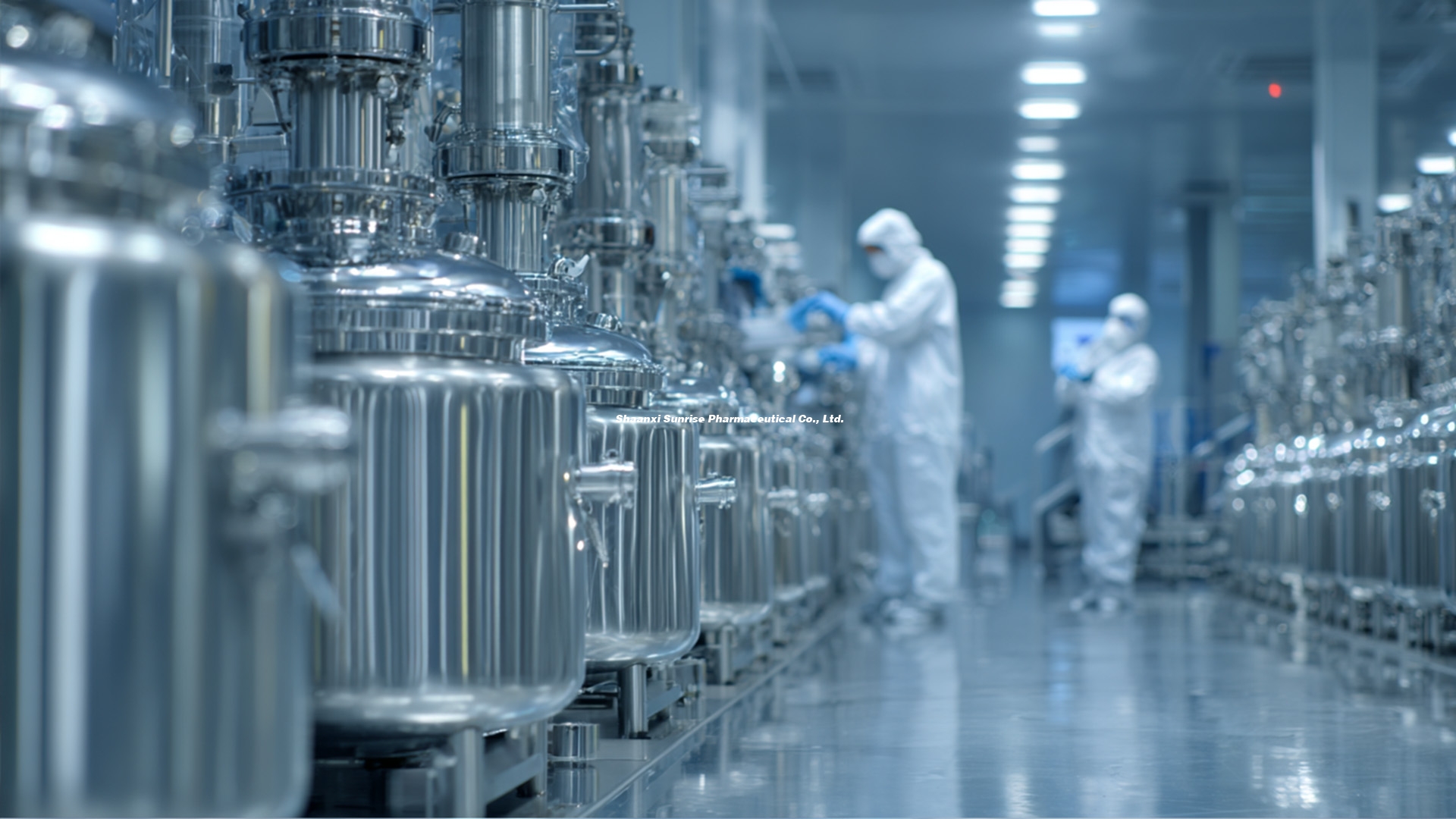
None of the efficacy data above means much if you can't reproduce it batch after batch. That's the part marketing copy usually skips. We run a pharmaceutical-grade plant, and we hold our peptide production to GMP standards. Our own low-temperature liquid-phase green synthesis was built to sidestep a lot of the headaches of traditional solid-phase work, less resin carrier and fewer rounds of chromatographic cleanup, and it comes out as low-hygroscopic, stable crystals and solutions that don't drift from one lot to the next. Whether you need a kilogram of powder for a stability study or tons of solution to feed a global launch, the spec sheet is the same.
So when you're vetting a cosmetic peptide supplier, the questions worth asking come down to a handful. Can they show a CoA for every batch? Will the purity hold at scale, or only in a lab beaker? Do they stand behind their efficacy claims with real data? Any supplier worth your time answers those without hedging.
How to Choose a Cosmetic Peptide Supplier
Verify the manufacturing standard. GMP certification and a written process description tell you more than a glossy brochure.
Ask for the CoA on every batch. HPLC purity, assay, heavy metals, residual solvents. If it's not on paper, it didn't happen.
Check that quality survives scale. Lab powder and ton-scale solution should read the same on the spec sheet.
Demand the data behind the claims. Real suppliers share in-vitro and clinical studies; the rest just point at a website.
Watch batch consistency. Lot-to-lot drift is a top reason formulas fail in the field, so insist on multi-lot documentation.
Confirm regulatory support. INCI, TDS, MSDS, and REACH/registration documents are the price of entry for global brands.
Frequently Asked Questions
What's the difference between pharmaceutical grade and cosmetic grade peptides?
Pharmaceutical grade means GMP manufacturing with enforced purity, impurity and heavy-metal limits, plus documented batch consistency. Cosmetic grade can mean almost anything, so buying from a certified manufacturer is the simplest way to protect both your formula and your compliance.
Which peptide works best for anti-aging skincare formulation?
Depends on the target. Dynamic wrinkles call for Acetyl Hexapeptide-8 (Argireline); collagen support and firming point to Palmitoyl Tripeptide-5 and Hexapeptide-9; brightening and elasticity start with GHK-Cu. Most premium formulas blend several rather than pick one.
Can I buy bulk cosmetic peptide powder straight from a manufacturer?
Yes. A GMP manufacturer will typically supply peptide powder from small R&D lots up to ton-level solution, with CoA and technical documentation. Buying direct cuts cost and tightens your supply chain.
How stable are peptide powders in formulation and storage?
It depends on the peptide's chemistry and hygroscopicity. Low-hygroscopic, high-stability crystals from green-synthesis processes tend to hold up better on the shelf than conventional peptides, which are more prone to degradation and batch drift.
Do cosmetic peptides have verifiable whitening and anti-wrinkle efficacy?
Some do, and the evidence is on the record: Nonapeptide-1's melanin suppression in B16F10 assays, Argireline's wrinkle-length reduction. The catch is that numbers vary by formulation and concentration, so always request the underlying study from your supplier before you put them in a claim.
Conclusion
Put it all together and the picture is straightforward. Brightening and regeneration? GHK-Cu. Melanin control? Nonapeptide-1. Dynamic wrinkles? Argireline. Collagen and deep firming? Palmitoyl Tripeptide-5 with Hexapeptide-9. These nine cosmetic peptides are well-characterized, and they give a formulator real, mechanism-driven options instead of guesswork. What usually separates a formula that performs from one that flops is the quality of the raw material behind it. That's why, when we talk about sourcing pharmaceutical grade cosmetic peptides, we'd rather point you to a manufacturer with stable, ton-scale GMP production than chase the cheapest quote on the board.
Source Cosmetic Peptides with Confidence
Jitai Biotech supplies high-purity peptide powder and peptide solution from R&D batches up to ton scale, with GMP production and full technical documentation. Ask us for a quote, a CoA, or a sample to run through your own lab before you commit.
Request a QuoteDisclaimer: This article is for technical and informational purposes. Efficacy figures reflect manufacturer-reported in-vitro and clinical study data and will vary with formulation and concentration. Nothing here is medical advice.